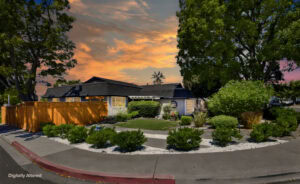

Selling Your Bay Area Home Starts With the Right Strategy
Selling a home in the Bay Area in 2026 requires more than choosing a price and putting the property on the MLS.
Your home may represent years of memories, hard work and financial commitment. When it is time to sell, decisions involving value, preparation, pricing, disclosures, marketing, offers, timing and net proceeds can shape both your financial outcome and your experience.
The Bay Area continues to have relatively constrained housing supply, but buyers are also highly conscious of mortgage rates, property condition and total monthly housing costs. That means a seller cannot rely only on a regional headline or a neighbor’s past sale.
The strongest strategy begins with understanding how your particular property fits today’s competition.
If you are already considering a sale, begin by requesting a personalized Bay Area home-value estimate.
Quick Answer: What Is the Best Way to Sell a Bay Area Home in 2026?
The strongest approach is to determine value from current comparable sales, prepare the property selectively, price according to today’s competition, complete disclosures carefully, market the home professionally and evaluate offers by price, terms, financing, risk and estimated net proceeds.
Bay Area conditions can change substantially by city, property type, price range and even micro-location, so a property-specific strategy is usually more useful than broad averages.
Key Takeaways for Bay Area Home Sellers
- Price from today’s market—not yesterday’s expectations.
- Compare recent sales with current active and pending competition.
- Improve what matters without automatically over-renovating.
- Prepare California disclosures early and carefully.
- Treat the first days on market as an important launch period.
- Do not assume the highest-priced offer is automatically the strongest.
- Calculate estimated net proceeds, not simply the headline sale price.
- Build the selling strategy around your property, timeline and next move.
2026 Bay Area Housing Market Snapshot
The latest California Association of REALTORS® housing release available at this update was published August 17, 2026 and covers July 2026 existing single-family detached homes.
| Metric | Current Reading | Comparison | Seller Meaning |
|---|---|---|---|
| Bay Area median sale price | $1,285,000 | -1.2% YoY | Regional price slightly below July 2025 |
| Bay Area sales activity | — | -0.1% YoY | Sales essentially flat year over year |
| Unsold Inventory Index | 2.3 months | 2.7 months July 2025 | Supply remains relatively constrained |
| Median time on market | 22 days | 24 days July 2025 | Well-positioned homes can still move efficiently |
| 30-year fixed mortgage rate | 6.65% | Aug. 20, 2026 | Buyer affordability remains important |
For the underlying market report, review the California Association of REALTORS® July 2026 Housing Report.
For current mortgage-rate information, see the Freddie Mac Primary Mortgage Market Survey.
The takeaway for sellers is important:
Limited inventory does not mean buyers will accept any price.
Buyers continue to compare monthly payment, property condition, location and competing inventory carefully.
Is 2026 a Good Time to Sell a Bay Area Home?
It can be—but the better question is:
Is this the right time for you to sell this particular property?
Trying to identify the absolute top of a housing cycle is extremely difficult.
Instead, evaluate four practical questions.
1. What Would Your Home Realistically Sell For Today?
Use recent relevant sales, current competing homes and local buyer activity rather than relying only on an automated estimate.
You can begin with a personalized Bay Area home-value estimate.
2. What Would You Likely Net?
Your sale price and your net proceeds are different numbers.
Potential deductions can include:
- Mortgage payoff
- Liens
- Brokerage compensation
- Escrow and title-related charges
- Transfer taxes
- Repairs
- Staging
- Seller concessions
- HOA charges
- Tax obligations
3. What Happens After the Sale?
Are you:
- Buying another Bay Area home?
- Downsizing?
- Relocating?
- Moving closer to family?
- Retiring?
- Selling an investment property?
- Moving outside California?
Your next move can affect both timing and contract strategy.
4. What Is Happening Around Your Property?
A regional report cannot tell you that three competing homes entered your immediate market this week.
Before spending money or establishing a list price, consider a personalized Bay Area home-selling consultation.
How Much Is Your Bay Area Home Worth?
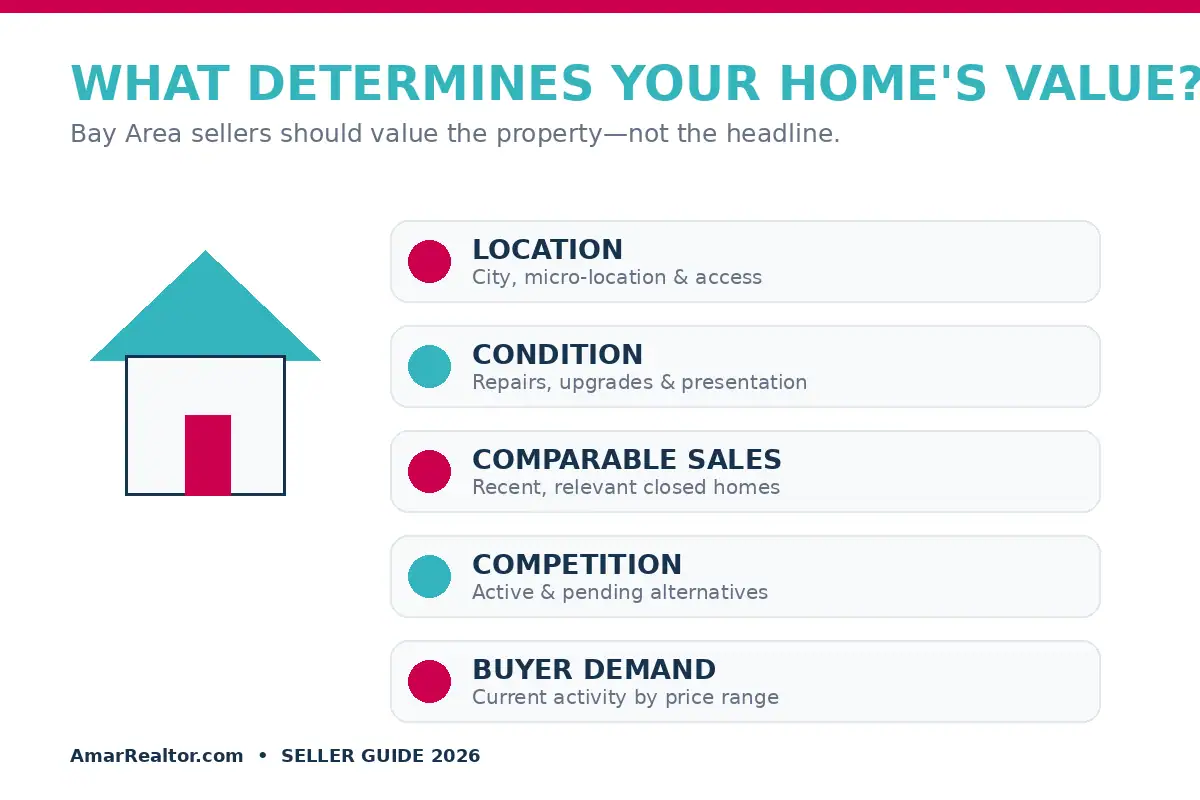
A home’s probable market value should be based on comparable properties and current competition, not simply one algorithm or one neighbor’s sale.
A useful comparative market analysis should consider:
- Recent closed sales
- Current active listings
- Relevant pending properties
- Property type
- Square footage
- Functional floor plan
- Lot size
- Condition
- Renovations
- Views
- Parking
- HOA costs
- Location influences
- Price reductions
- Current buyer demand
Why County Averages Are Not Enough
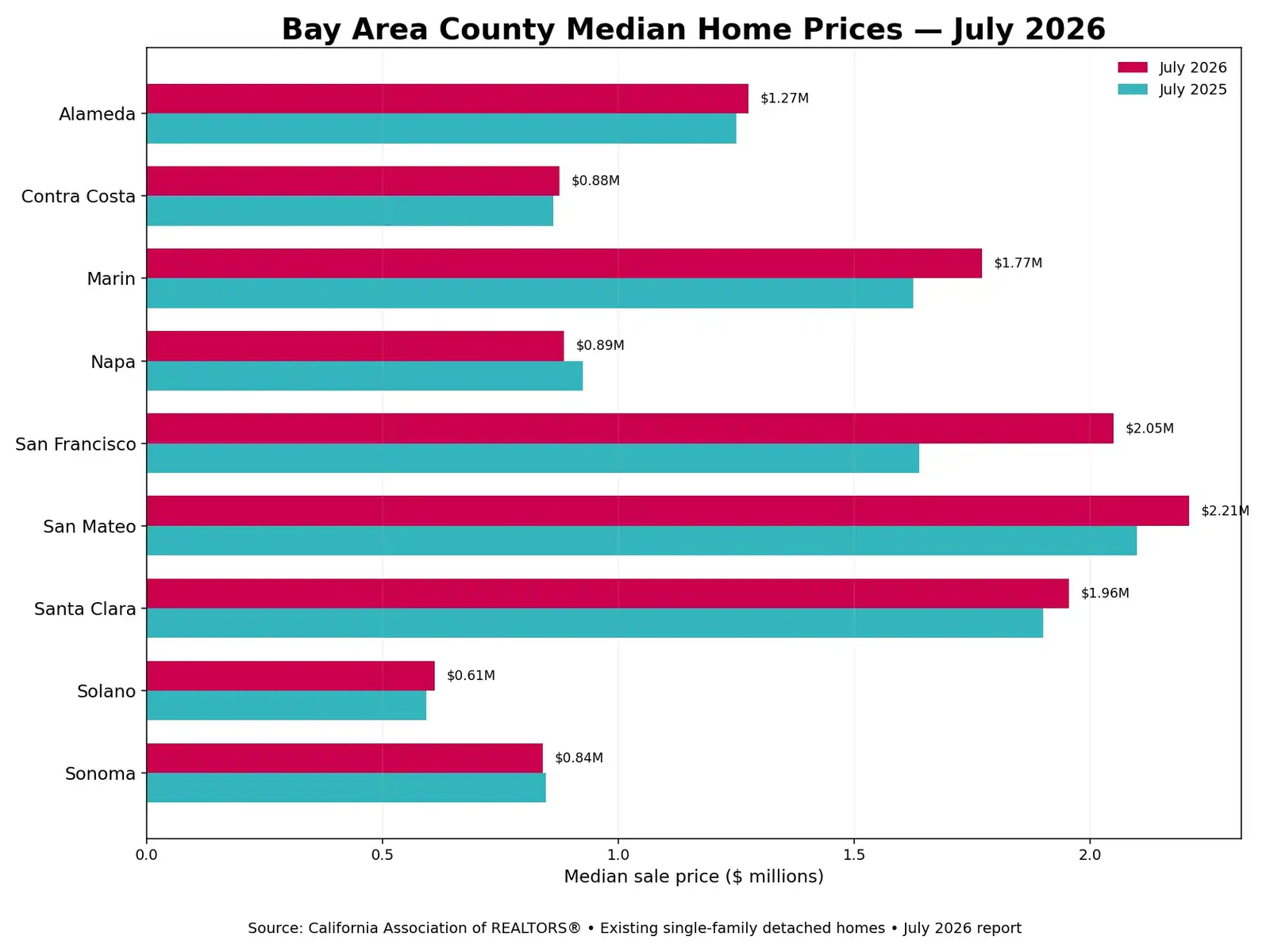
C.A.R.’s July 2026 existing single-family medians illustrate how different Bay Area markets can be:
- Santa Clara County: $1.955 million
- San Mateo County: $2.21 million
- San Francisco: $2.05 million
- Alameda County: $1.275 million
- Contra Costa County: $875,000
Those numbers provide context.
They do not determine your home’s value.
C.A.R. itself cautions that changes in median prices can reflect differences in the mix and characteristics of homes sold.
Your home should therefore be analyzed as a specific property.
Market Value Is Not the Same as List Price
These two concepts are connected, but they are not identical.
Market Value
An estimate of what informed buyers may reasonably be willing to pay under current conditions.
List Price
A strategic marketing and negotiation decision.
Sometimes they may be very close.
Other times, the listing strategy may intentionally position the property around an important buyer-search threshold or competitive price band.
The goal is not to select the most flattering number.
The goal is to create the strongest possible market position for the property.
Online Home Estimate vs. Property-Specific Analysis
Online valuation tools can be useful for an initial reference point.
However, an algorithm may not fully understand:
- Remodeling quality
- Interior condition
- Natural light
- Functional layout
- Lot usability
- Views
- Deferred maintenance
- Landscaping
- Location within a neighborhood
- Very recent competition
Before deciding how much to spend preparing the property, request a personalized home-value estimate.
How Should You Price Your Bay Area Home?
Pricing is one of the most consequential decisions in the selling process.
Many sellers understandably think:
“Let’s start high. We can always reduce it later.”
The problem is that your strongest buyer attention often comes near the beginning of the listing.
If buyers immediately see the property as overpriced:
- Showing activity may weaken
- Buyers may wait for a reduction
- Market time can accumulate
- Competing homes can become more attractive
- Buyers may begin wondering why the property has not sold
- A later reduction may not fully recreate launch momentum
Build Pricing Around Evidence
Your pricing strategy should consider:
- Recent closed sales
- Current competing listings
- Pending activity
- Property condition
- Current inventory
- Buyer activity
- Price-search thresholds
- Appraisal support
- Seller timeline
- Current market direction
A property-specific pricing strategy can begin with a Bay Area home-selling consultation.
What Should You Repair Before Selling?
One of the biggest seller questions is:
“Should I remodel before I sell?”
Not automatically.
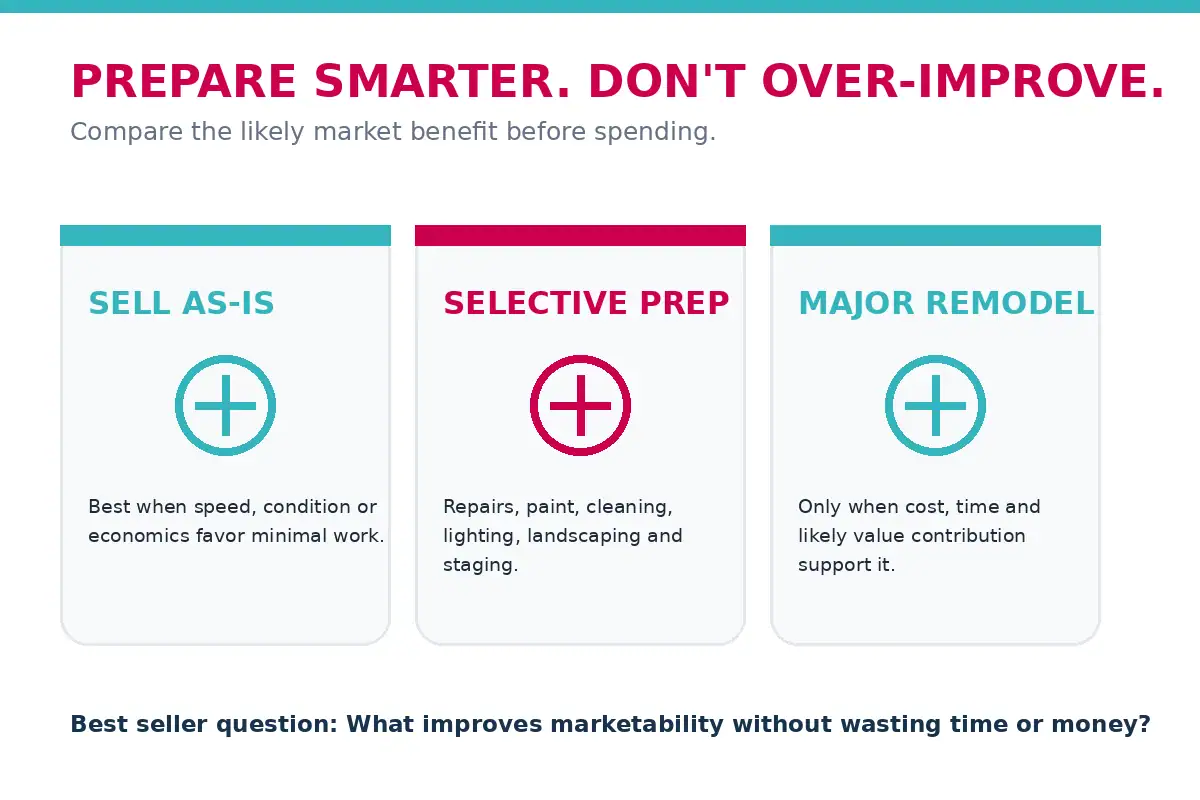
Before spending money, divide the work into three categories.
Necessary Repairs
Potential examples:
- Water leaks
- Broken fixtures
- Electrical concerns
- Plumbing issues
- Roof problems
- Dry rot
- Damaged flooring
- Moisture problems
- Safety concerns
High-Impact Presentation Improvements
Examples may include:
- Fresh paint
- Deep cleaning
- Improved lighting
- Landscaping
- Decluttering
- Minor flooring work
- Exterior touch-ups
- Updated hardware
Major Remodeling
Examples:
- Complete kitchen remodel
- Complete bathroom renovation
- Structural reconfiguration
- Room addition
- Extensive luxury upgrades
A $100,000 improvement does not automatically create $100,000—or more—of market value.
Compare Three Strategies Before Spending
Consider:
Option A — Sell as-is
Option B — Complete selective preparation
Option C — Complete substantial renovation
For each, compare:
- Cost
- Time
- Probable buyer reaction
- Potential contribution to marketability
- Risk
- Seller convenience
The goal is not to create the most expensive version of the property.
The goal is to determine which preparation strategy makes the most sense before going to market.
Should You Stage Your Home?
Staging can help buyers understand how the space functions and envision living there.
Depending on the property, this could involve:
- Full vacant-home staging
- Partial staging
- Editing existing furniture
- Removing oversized furniture
- Styling important rooms
- Improving lighting
- Exterior presentation
- Professional photography preparation
Staging should improve presentation—not conceal defects.
Photography, staging and property preparation should work together as one coordinated marketing strategy.
How Much Does It Cost to Sell a House in California?
There is no accurate universal percentage that applies to every California home sale.
Potential seller expenses may include:
- Mortgage and lien payoff
- Brokerage compensation
- Buyer-related concessions when negotiated
- Escrow charges
- Title-related charges
- Documentary transfer taxes
- City transfer taxes
- HOA documents or transfer costs
- Repairs
- Staging
- Cleaning
- Landscaping
- Property-tax prorations
- Other transaction-specific charges
Real Estate Compensation Is Negotiable
Seller decisions regarding buyer-agent compensation are negotiable.
The National Association of REALTORS® Consumer Guide on Offers of Compensation explains that sellers may choose whether to authorize an offer of compensation and that an agent needs the seller’s written approval for such an offer.
Offers of compensation cannot be displayed on an MLS under current NAR rules.
Seller concessions are a separate concept and may also be negotiated in a purchase agreement.
Bay Area Transfer Taxes Can Be Highly Local
Seller closing costs can vary considerably by location.
For example, Santa Clara County provides current documentary transfer information through the Santa Clara County Clerk-Recorder.
Certain cities may impose additional transfer taxes.
For sellers in San Jose, review the city’s current Measure E Real Property Transfer Tax information.
This is why your financial planning should begin with a property-specific seller net sheet, rather than a generic percentage found online.
California Seller Disclosures
California sellers should treat disclosures as a central part of the transaction.
For many transfers involving one-to-four-unit residential properties, California law requires a Transfer Disclosure Statement, subject to statutory exemptions.
Review the California Department of Real Estate’s Disclosures in Real Property Transactions guide.
Depending on the property and transaction, disclosure materials may address:
- Known defects
- Repairs and additions
- Roof concerns
- Water intrusion
- Structural conditions
- Electrical or plumbing issues
- Environmental conditions
- HOA information
- Insurance-related matters
- Natural hazards
- Other known material facts
The guiding principle should be straightforward:
Do not attempt to make a known material problem disappear by failing to disclose it.
If you are uncertain about a legal disclosure requirement, consult the appropriate qualified real-estate or legal professional.
Natural Hazard Considerations
California properties can potentially fall within designated hazard areas involving:
- Fire
- Flood
- Earthquake fault zones
- Seismic hazards
- Other mapped natural hazards
The California Geological Survey provides information about geological and seismic hazards.
Property-specific disclosure requirements should be reviewed as part of the individual transaction.
Should Sellers Get Inspections Before Listing?
Sometimes.
Pre-sale inspections can help sellers understand the property’s condition before buyers begin their own evaluation.
Depending on the home and local practice, inspections may include:
- General property inspection
- Structural pest inspection
- Roof inspection
- Chimney inspection
- Sewer lateral inspection
- Foundation evaluation
- Specialist inspection when warranted
Potential benefits may include:
- Discovering issues sooner
- Planning repairs intentionally
- Improving disclosure quality
- Giving buyers more information earlier
- Reducing unexpected discoveries later
Pre-sale inspection strategy should depend on the property’s age, condition, market, seller goals and local practice.
How Should a Bay Area Home Be Marketed?
Strong marketing begins before the listing goes live.
The goal is not simply to create attractive photographs.
It is to present the property clearly, reach relevant buyers and make it easy for them to understand its features and value.
A Complete Marketing Launch May Include
Professional Photography
Buyers often experience the property online before they ever walk through the door.
Photography should accurately and attractively represent:
- Exterior
- Living spaces
- Kitchen
- Bedrooms
- Bathrooms
- Outdoor areas
- Views
- Important property features
Floor Plan
A floor plan helps buyers understand room relationships and functional flow.
Professional Video
Video can communicate movement through the property and overall experience in ways that still photography cannot.
Property Description
The description should emphasize accurate property characteristics and useful lifestyle features while complying with Fair Housing advertising principles.
MLS and Online Exposure
A marketing campaign may include:
- MLS exposure
- Online syndication
- Property website
- Agent networking
- Email marketing
- Social media
- Video promotion
- Open-house promotion
- Private showings
To see examples of previous representation, review homes sold by Amar, REALTOR®.
For additional perspective, read Bay Area buyer and seller client reviews.
Your First Days on the Market Matter
The initial market response can provide valuable information.
Monitor:
- Showing activity
- Online engagement
- Open-house attendance
- Buyer questions
- Agent feedback
- Disclosure activity
- Offer interest
- New competing listings
If activity is substantially weaker than expected, examine the reason.
Possible causes can include:
- Price
- Condition
- Presentation
- Access
- Competition
- Property-specific objections
- Changing market conditions
Use actual market feedback rather than reacting emotionally.
How Should Sellers Compare Offers?
The highest offer is not automatically the strongest offer.
An offer is a combination of:
PRICE + TERMS + FINANCING + RISK + TIMING + NET PROCEEDS
[IMAGE — compare-home-sale-offers-bay-area.webp]
| Offer Component | Why It Matters |
| Purchase price | Headline financial consideration |
| Down payment | May influence financing profile |
| Loan preapproval | Helps assess financing readiness |
| Proof of funds | Helps verify available cash |
| Loan terms | Can affect closing certainty |
| Appraisal terms | Can create valuation exposure |
| Inspection terms | May affect renegotiation risk |
| Other contingencies | Affect certainty and timing |
| Closing date | Should fit seller plans |
| Possession | Determines seller move timing |
| Seller credits | Reduce effective seller proceeds |
| Other requests | Can materially change the economics |
NAR’s consumer guide to navigating multiple offers similarly notes that financial terms, contingencies, closing timeline and earnest money can make an offer more or less attractive, and the strongest offer is not necessarily the highest-priced one.
Example
Imagine:
Offer A
$2,000,000
But it includes:
- Larger seller credits
- More contingencies
- Weaker financing
- Longer closing period
Offer B
$1,975,000
But it includes:
- Stronger financial documentation
- Fewer uncertainties
- Lower requested credits
- A closing schedule better aligned with the seller
Which is better?
The answer cannot be determined by purchase price alone.
What Happens After You Accept an Offer?
Offer acceptance begins the escrow and closing process.
Depending on the contract, the transaction may include:
- Earnest-money deposit
- Buyer inspections
- Contingency periods
- Appraisal
- Loan underwriting
- Seller obligations
- Title work
- Escrow documentation
- Final verification
- Signing
- Loan funding
- Recording
- Possession
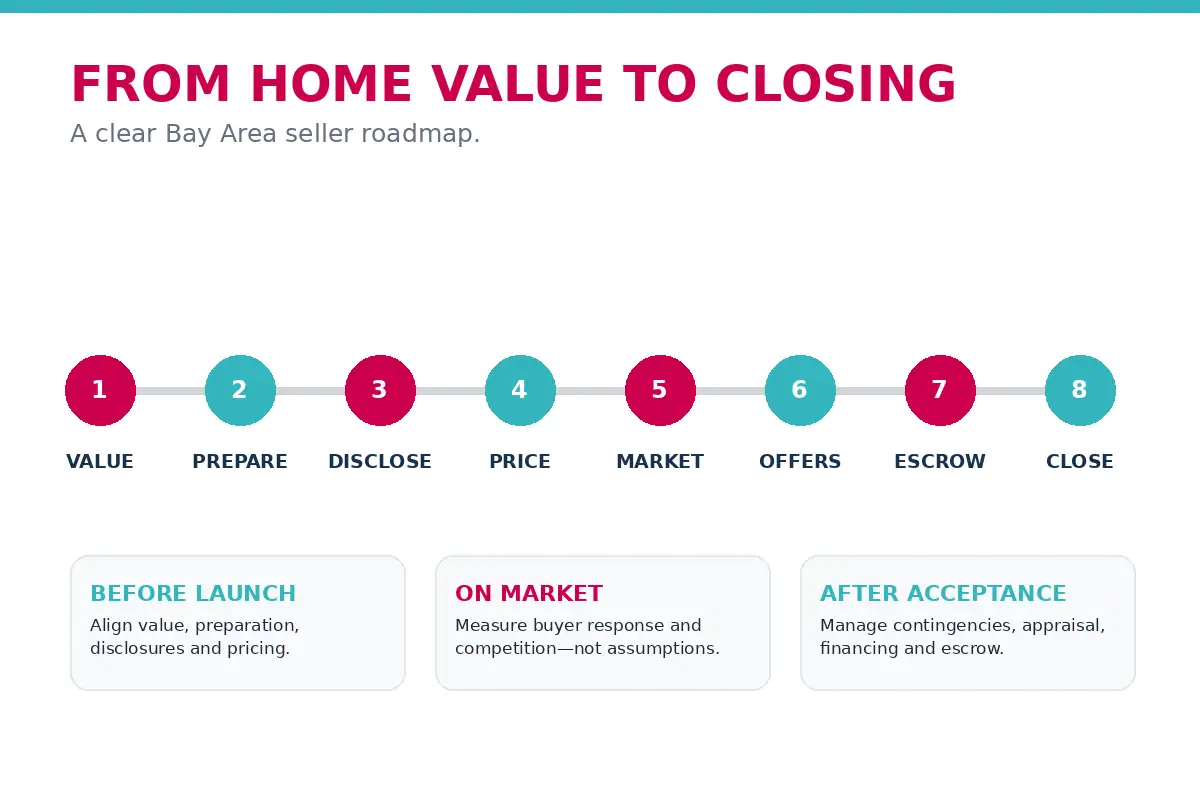
The exact sequence and timing depend on the contract.
Contractual deadlines should be monitored carefully throughout escrow.
How Do Bay Area Housing Markets Differ?
There is no single Bay Area housing market.
Conditions can differ across:
- San Jose
- Milpitas
- Santa Clara
- Cupertino
- Sunnyvale
- Mountain View
- Palo Alto
- Los Gatos
- Saratoga
- Fremont
- Newark
- Union City
- Pleasanton
- Dublin
- San Mateo
- Redwood City
- Menlo Park
- Other Bay Area communities
Even two homes in the same city can attract different buyer responses because of:
- Micro-location
- Property type
- Price range
- Lot size
- Condition
- Functional layout
- Parking
- HOA costs
- Competing inventory
- Buyer demand
Property Type Matters
A single-family home, townhome and condominium can serve very different buyer pools even when located close together.
Price Range Matters
Buyer behavior at $900,000 can differ significantly from buyer behavior at:
- $1.5 million
- $2 million
- $3 million
- $5 million+
Financing structures, available inventory and buyer expectations change across price segments.
Your property should therefore be valued and marketed as an individual property—not as a Bay Area average.
What This Means for Bay Area Sellers
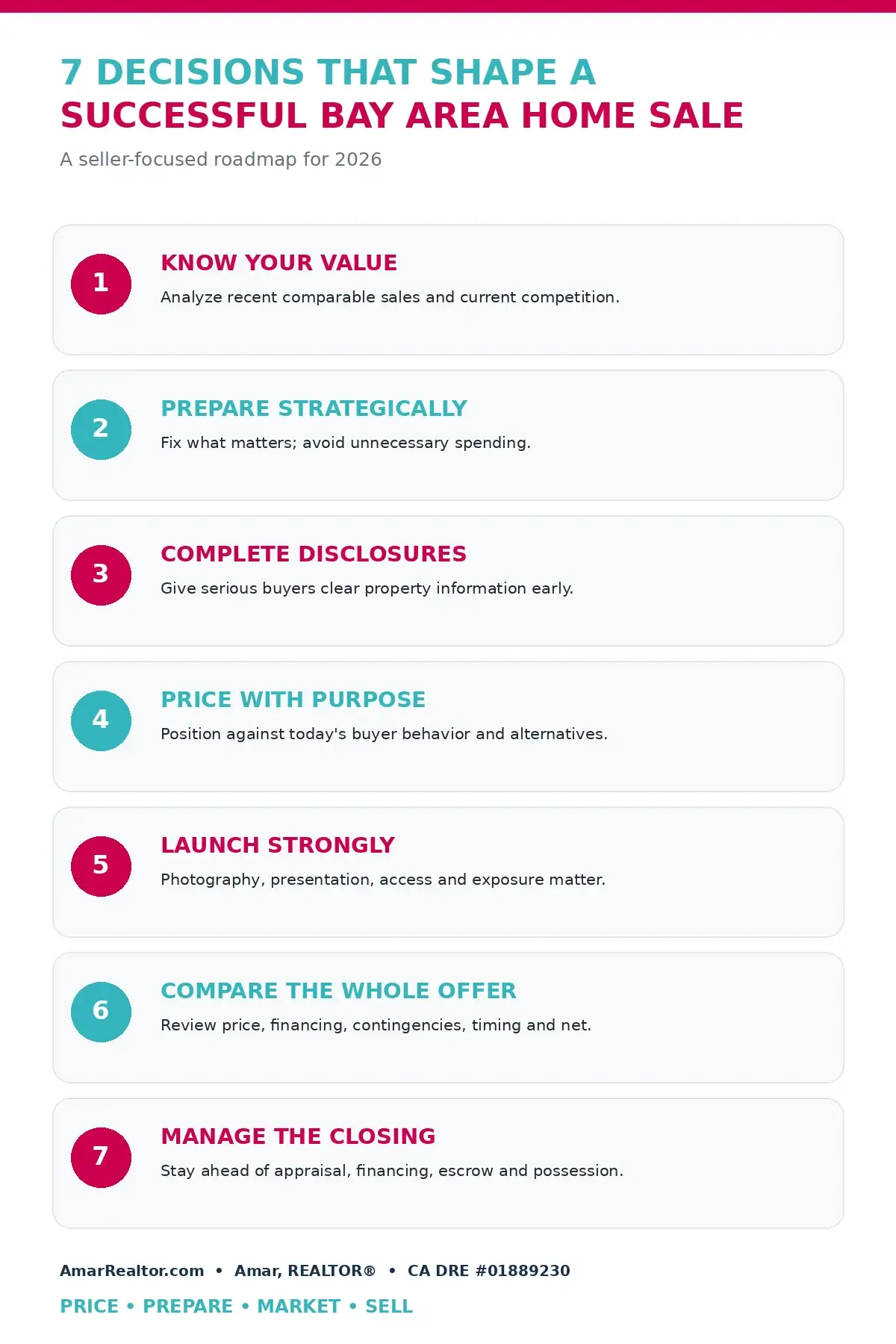
Your selling strategy should answer five questions.
What is the property worth now?
Use current comparable sales and competition.
What preparation is worthwhile?
Address the work that improves marketability without automatically overspending.
How should the home be priced?
Position the listing against today’s alternatives and buyer behavior.
How will qualified buyers discover it?
Develop the marketing campaign before launch.
How will offers be evaluated?
Compare price, terms, financial strength, timing, risk and estimated net proceeds.
Common Bay Area Home-Selling Mistakes
1. Pricing Based on Emotion
Your memories may be priceless.
Market value is determined by buyer behavior and competing alternatives.
2. Treating an Automated Estimate as the Final Answer
Algorithms may not fully account for condition, remodeling quality, lot characteristics or immediate market activity.
3. Over-Renovating
Do not spend heavily simply because you assume the market will return the same or greater amount.
Analyze the likely benefit first.
4. Under-Preparing
Small issues can disproportionately influence first impressions.
These may include:
- Poor lighting
- Dirty windows
- Clutter
- Overgrown landscaping
- Damaged paint
- Minor unrepaired items
5. Incomplete Disclosures
California sellers should take disclosure obligations seriously.
Review the California Department of Real Estate disclosure guidance.
6. Accepting an Offer Based Only on Price
Compare the complete financial and contractual package.
7. Ignoring Net Proceeds
The sale price is not the same as the amount the seller ultimately retains.
Step-by-Step Bay Area Home-Selling Plan
Step 1 — Define Your Goal
Clarify why you are selling, when you want to move and what comes next.
Step 2 — Determine Current Market Value
Review relevant sales and current competition.
Start with a personalized Bay Area home-value estimate.
Step 3 — Estimate Net Proceeds
Review payoff amounts, selling expenses, taxes and other obligations.
Step 4 — Build the Preparation Plan
Separate necessary repairs from optional improvements and unnecessary renovations.
Step 5 — Prepare Disclosures
Organize important property information early.
Step 6 — Determine Pricing Strategy
Evaluate sold, active and pending properties, buyer demand and property condition.
Step 7 — Create Marketing Assets
Complete photography, floor plans, staging, copy and video before launch whenever possible.
Step 8 — Launch the Property
Create the strongest reasonable first impression.
Step 9 — Measure Buyer Response
Watch actual activity and feedback.
Step 10 — Evaluate Offers Strategically
Compare:
Price + Terms + Financing + Risk + Timing + Net
Step 11 — Manage Escrow
Stay ahead of contractual deadlines, appraisal, financing and documentation.
Step 12 — Coordinate Your Next Move
Plan possession and the transition to your next home.
[SHORT VIDEO — selling-your-bay-area-home-2026-short-video.mp4]
Tax Considerations When Selling a California Home
For Bay Area homeowners with substantial appreciation, taxes can become an important planning consideration.
The IRS explains home-sale rules in Publication 523: Selling Your Home.
Qualifying taxpayers may potentially exclude up to $250,000 of gain, or up to $500,000 for certain married couples filing jointly, subject to IRS eligibility requirements.
Tax treatment can become more complicated when the property has:
- Been rented
- Been used for business
- Been depreciated
- Been inherited
- Been jointly owned
- Been involved in an exchange
- Experienced substantial appreciation
California also has real-estate withholding requirements in certain transactions. Review current guidance through the California Franchise Tax Board Real Estate Withholding page.
Consult a qualified tax professional regarding your specific circumstances.
Amar REALTOR® Local Perspective
Bay Area market headlines can help homeowners understand the larger environment.
But they are rarely enough to determine the right strategy for one individual property.
The most useful seller analysis begins where the broad statistics end:
your home.
What has recently sold nearby?
What is competing today?
How does your home’s condition compare?
What are buyers responding to?
How much preparation is financially sensible?
What pricing strategy fits the current market?
Which offer terms matter most to your next move?
Sometimes the right strategy is additional preparation.
Sometimes it is not spending more money.
Sometimes maximizing market exposure is the highest priority.
For another seller, timing, certainty or privacy may matter more.
The goal should not be to force every seller into one formula.
The goal is to understand your options and build a strategy around your property, your priorities and your next chapter.
For a property-specific conversation, schedule a personalized Bay Area home-selling consultation.
Frequently Asked Questions
Is 2026 a Good Time to Sell a Home in the Bay Area?
It can be. Bay Area inventory remained relatively constrained in July 2026, but results differed considerably by county and property. Your decision should be based on local competition, probable value, expected net proceeds and your personal timeline rather than one regional headline.
How Long Does It Take to Sell a Bay Area Home?
It varies. C.A.R. reported a Bay Area median of 22 days on market for existing single-family homes in July 2026. Individual properties may sell considerably faster or slower depending on pricing, location, property type, condition and demand. Closing time after acceptance must also be considered.
How Do I Determine What My Bay Area Home Is Worth?
Start with relevant recent closed sales and current competing properties, then adjust for differences in size, lot, condition, layout, location and upgrades.
For property-specific analysis, request a personalized Bay Area home-value estimate.
Should I Renovate Before Selling?
Not automatically. Compare the expected cost and delay with the probable benefit. In many situations, targeted repairs, paint, cleaning, landscaping and presentation can be more practical than a major renovation.
Should I Stage My Home?
It depends on the property. Some vacant homes may benefit from complete staging, while occupied homes may need only decluttering, furniture editing, better lighting and professional photography.
What Disclosures Do California Sellers Need?
California residential disclosure obligations can be extensive and property-specific. Many one-to-four-unit residential resales involve a Transfer Disclosure Statement, subject to statutory exemptions.
Review the California Department of Real Estate disclosure guide and obtain appropriate professional guidance.
How Much Does It Cost to Sell a House in California?
There is no universal percentage. Costs can include mortgage payoff, brokerage compensation, escrow and title charges, transfer taxes, repairs, staging, HOA costs, seller concessions and other transaction-specific expenses.
Does a Seller Have to Pay the Buyer’s Agent?
No automatic payment is required. Compensation is negotiable. A seller can decide whether to authorize an offer of buyer-agent compensation, and current NAR rules require written seller approval for such an offer.
Should I Accept the Highest Offer?
Not necessarily. Review financing, appraisal exposure, contingencies, credits, closing date, proof of funds, possession and probability of closing together with purchase price.
What Is the First Step if I Am Considering Selling?
Understand two numbers first:
Your probable market value
and
Your estimated net proceeds
Then decide whether your selling timeline and preparation strategy fit your next move.
Final Thoughts: Sell With a Plan, Not Just a Price
Selling your Bay Area home is both a financial decision and an important life transition.
A strong sale begins before the listing becomes active.
Start with:
VALUE
Understand how the property compares with today’s market.
Then determine:
PREPARATION
Improve what matters without automatically overspending.
Build the:
PRICING STRATEGY
Position the home thoughtfully against current competition.
Execute the:
MARKETING
Give qualified buyers a compelling reason to discover and experience the property.
And when offers arrive, evaluate:
PRICE + TERMS + CERTAINTY + NET PROCEEDS
The goal is not simply to put a house on the market.
The goal is to make informed decisions at each stage so you can move forward with clarity and confidence.
[VISUAL CTA PLACEMENT]
Request Your Personalized Home Value & Selling Strategy
Thinking about selling your Bay Area home?
Before deciding on renovations, timing or a listing price, understand your home’s current competitive position and the strategies available to you.
Schedule Your Personalized Home-Selling Consultation