

Buying your first home in the Bay Area can feel overwhelming. You may be wondering how much money you need, whether you can qualify for a mortgage, if you really need 20% down, or whether California offers first-time buyer programs that could help.
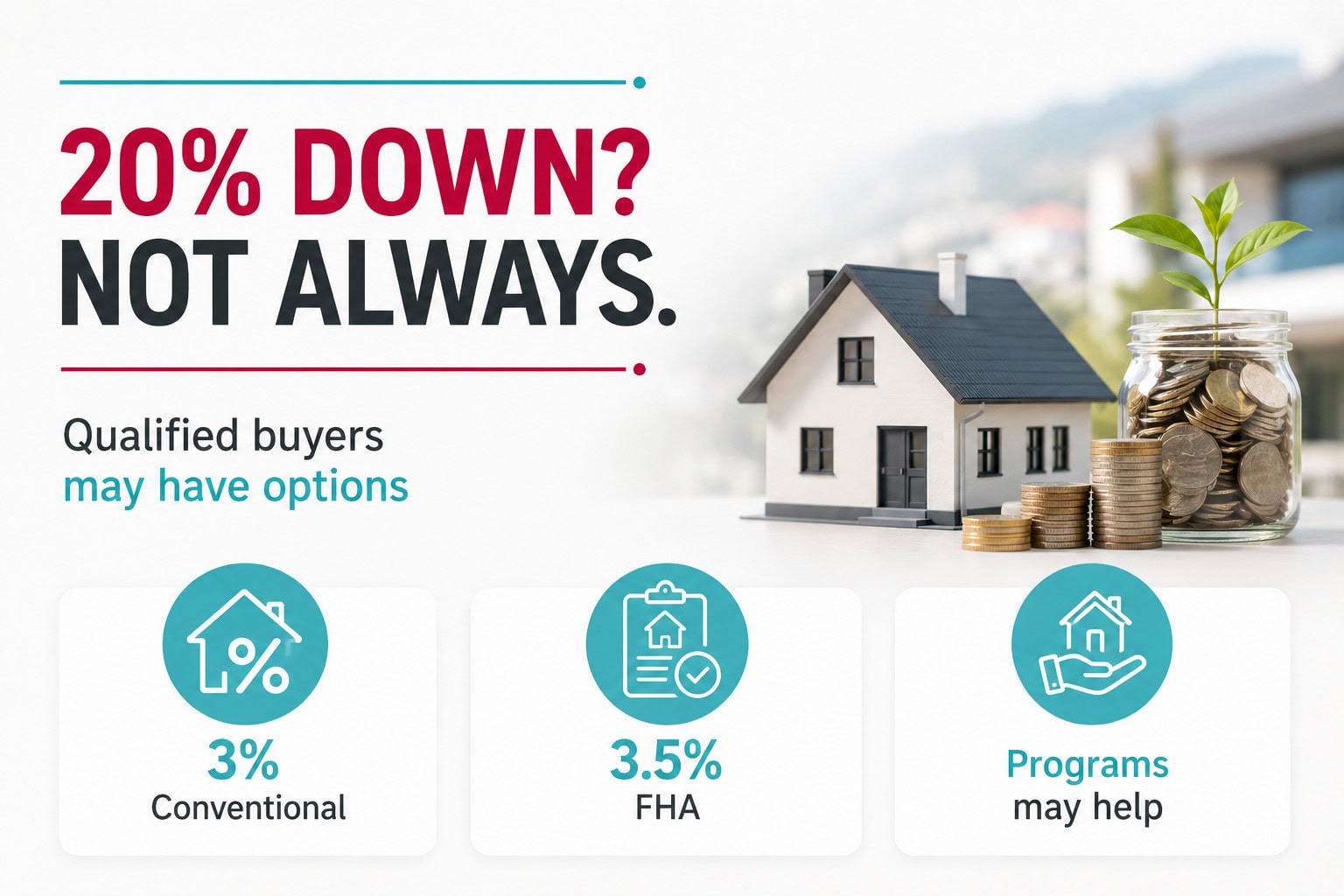
The encouraging news is that 20% down is not always required. Qualified borrowers may have conventional financing options with down payments as low as 3%, while FHA home loans may allow eligible borrowers to purchase with as little as 3.5% down.
California buyers may also explore CalHFA homebuyer programs, including down-payment assistance programs subject to eligibility, income limits, property requirements, and funding availability.
But buying successfully involves much more than qualifying for a mortgage.
The goal is to find the right HOME, at the right VALUE, with the right level of RISK for your financial situation and future plans.
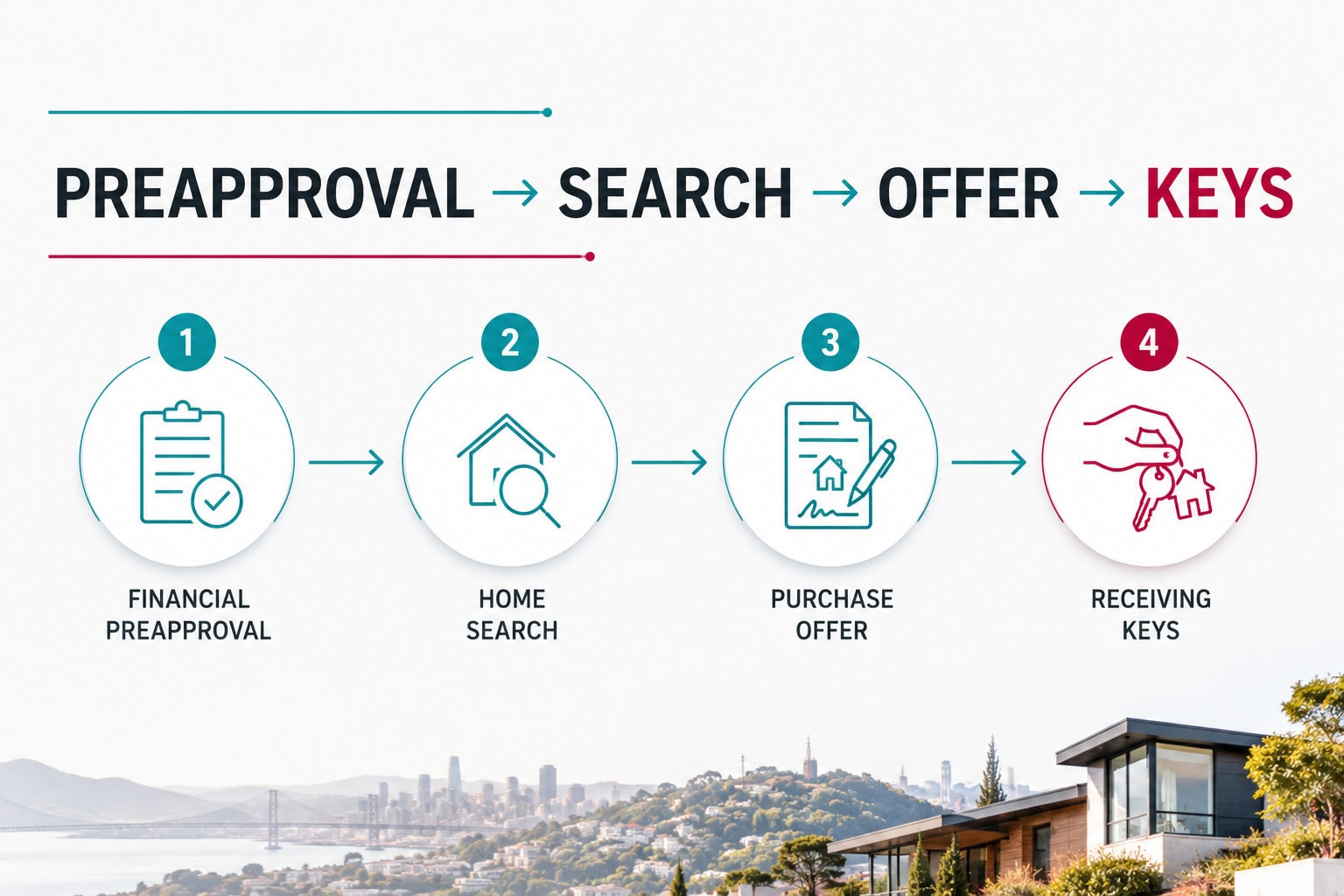
This complete Bay Area first-time buyer guide walks you from preapproval to keys.
Quick Answer: How Do You Buy Your First Home in the Bay Area?
Start by establishing a comfortable monthly housing budget, getting fully preapproved, and comparing conventional, FHA, and eligible California first-time buyer programs.
Then determine your preferred locations and property types, search for homes, review disclosures, analyze comparable sales, create a property-specific offer strategy, complete inspections and appraisal, obtain final loan approval, close escrow, and receive your keys.
If you want to establish your strategy before beginning serious home shopping, you can schedule a personalized Bay Area home-buying consultation.
Key Takeaways for First-Time Bay Area Buyers
- 20% down is not automatically required. Some qualified conventional buyers may have 3% down-payment options, while FHA financing may permit 3.5% down.
- Get fully preapproved before becoming emotionally attached to a property.
- Determine your comfortable monthly payment—not simply the maximum purchase price a lender approves.
- Research CalHFA first-time buyer programs early, since eligibility and availability vary.
- Analyze comparable sales and property condition instead of relying only on the listing price.
- Carefully review inspections, disclosures, insurance, financing, and contractual risks before committing.
- Maintain appropriate financial reserves after closing.
2026 First-Time Home Buyer Financing Snapshot
| Financing Topic | 2026 Information | Why It Matters |
|---|---|---|
| 30-Year Fixed Mortgage Average | 6.67% as of Aug. 13, 2026 | Rates directly affect purchasing power |
| FHA Minimum Down Payment | As low as 3.5% | 20% down is not universally required |
| Fannie Mae HomeReady | As low as 3% | Potential conventional option |
| Freddie Mac Home Possible | As low as 3% | Another low-down-payment option for eligible borrowers |
| CalHFA MyHome | Up to 3% or 3.5%, depending on first-mortgage type | May help eligible buyers with upfront costs |
| Dream For All | Up to 20%, capped at $150,000 | Shared-appreciation assistance for qualifying participants |
| 2026 High-Cost Conforming Ceiling | $1,249,125 for one-unit properties | Relevant in designated high-cost markets |
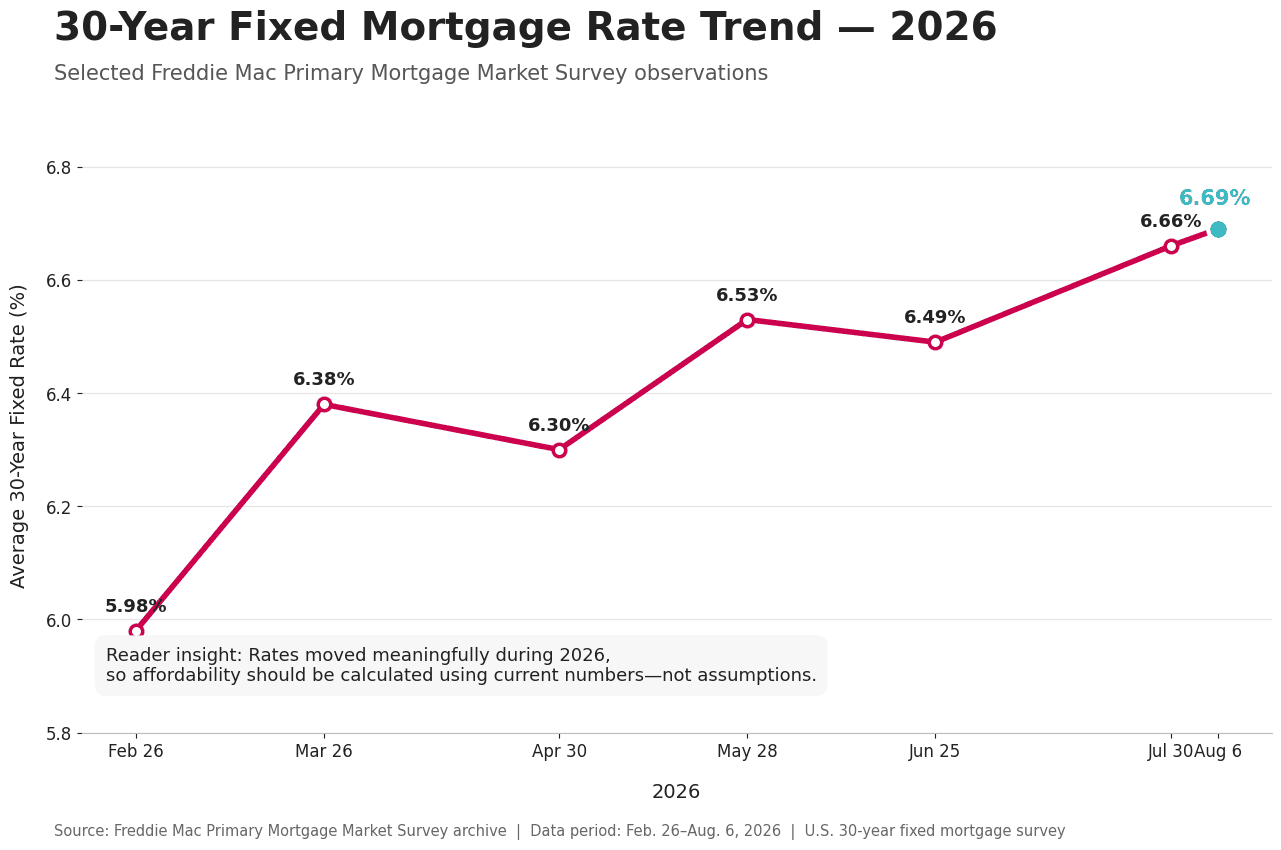
According to the Freddie Mac Primary Mortgage Market Survey, the average 30-year fixed mortgage was 6.67% on August 13, 2026, compared with 6.69% one week earlier. Your actual mortgage rate can differ based on credit, loan program, down payment, points, and lender pricing.
The Federal Housing Finance Agency’s 2026 conforming loan limits set the national one-unit baseline at $832,750 and the high-cost ceiling at $1,249,125. Always verify county-specific limits for the property you’re buying.
Start With Your Budget—Not the Home
One of the biggest mistakes first-time homebuyers make is beginning their journey with open houses and online listings.
Start with your finances instead.
Ask yourself:
- What monthly housing payment feels comfortable?
- How much cash can I use without exhausting my savings?
- How much should remain in emergency reserves after closing?
- What will property taxes add?
- What will homeowners insurance cost?
- Will the property have HOA dues?
- Will mortgage insurance apply?
- How much should I reserve for maintenance?
You can use Amar REALTOR®’s mortgage calculator to estimate your potential monthly mortgage payment as an initial planning tool.
But remember that affordability involves more than principal and interest.
Your Real Monthly Housing Cost May Include:
Principal + Interest + Property Taxes + Homeowners Insurance + Mortgage Insurance + HOA Dues + Maintenance
Your lender’s maximum approval amount is not necessarily your comfortable amount.
Get Preapproved Before Serious Home Shopping
Once you understand your budget, the next major step is mortgage preapproval.
A strong preapproval allows you to understand:
- Your potential purchase range
- Expected down payment
- Estimated cash needed to close
- Loan options
- Approximate monthly payment
- Potential mortgage insurance
- Financial reserves
- Documentation requirements
Do not ask your lender only:
“What’s the maximum home price I qualify for?”
Instead ask for several scenarios.
For example:
- 20% down conventional
- 10% down conventional
- 5% down conventional
- 3% down conventional, if eligible
- FHA financing
- CalHFA financing, if eligible
This allows you to compare monthly costs and cash requirements before deciding how aggressively you want to shop.
When you are ready to coordinate your financing strategy with your property-search strategy, schedule a personalized Bay Area home-buying consultation.
How Much Down Payment Do First-Time Buyers Need?
You May Not Need 20%
The belief that every buyer must make a 20% down payment prevents some prospective homeowners from exploring their options.
Several mortgage programs permit lower down payments for qualified borrowers.
Fannie Mae HomeReady
The Fannie Mae HomeReady mortgage allows qualifying borrowers to make a down payment as low as 3%. Eligibility requirements apply.
Freddie Mac Home Possible
The Freddie Mac Home Possible mortgage also provides a 3% down-payment option. Qualifying income generally cannot exceed 80% of the applicable area median income.
Freddie Mac HomeOne
Qualified first-time buyers can also investigate Freddie Mac HomeOne, which offers a low-down-payment option starting at 3% for eligible borrowers.
FHA Financing
The U.S. Department of Housing and Urban Development states that eligible borrowers using FHA financing may have a minimum down payment of 3.5%.
Should You Put Down the Minimum?
Not necessarily.
A smaller down payment may allow you to preserve cash for:
- Closing costs
- Emergency reserves
- Repairs
- Furnishings
- Moving expenses
- Future financial goals
However, a smaller down payment may also mean:
- A larger mortgage balance
- Higher monthly payments
- Mortgage insurance
- Less initial equity
There is no single percentage that is right for every first-time buyer.
Compare the complete financial picture.
Explore California First-Time Home Buyer Programs
California buyers should investigate assistance programs before beginning serious home shopping.
CalHFA MyHome Assistance Program
The CalHFA MyHome Assistance Program provides a deferred-payment junior loan that may assist eligible buyers with down payment and/or closing costs.
For CalHFA government loans such as FHA, MyHome assistance may equal up to the lesser of 3.5% of the purchase price or appraised value. For qualifying CalHFA conventional financing, assistance may be up to 3%.
Buyers should also review current CalHFA borrower eligibility requirements, including applicable first-time buyer and homebuyer-education requirements.
California Dream For All
The California Dream For All Shared Appreciation Loan Program can provide qualifying participants assistance of up to 20% of the purchase price or appraised value, capped at $150,000.
This program is different from a traditional grant because it involves shared appreciation and detailed eligibility requirements.
CalHFA stated that reservations for the 2026 voucher round began July 15, 2026. Because participation is allocation-based, buyers should verify current availability directly with CalHFA and an approved lender.
FHA vs. Conventional Loan: Which Is Better?
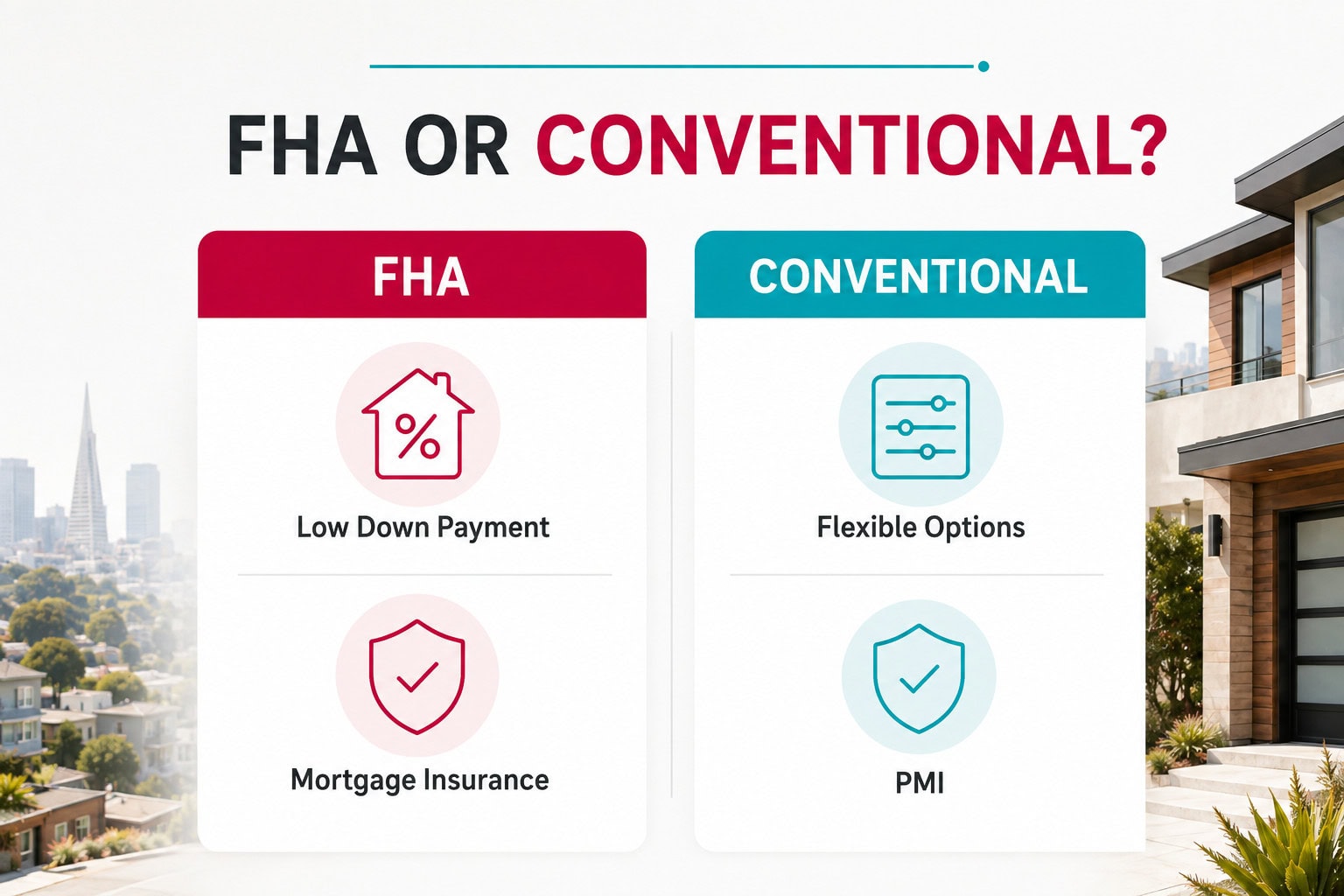
Neither is automatically better.
The appropriate loan depends on the individual buyer.
FHA May Be Worth Exploring If:
- Your available down payment is limited.
- FHA underwriting better fits your financial profile.
- FHA creates a more manageable financing structure.
- Your target property meets applicable FHA requirements.
Learn more directly from HUD’s official FHA home-loan information.
Conventional Financing May Be Worth Exploring If:
- Your credit profile supports competitive conventional pricing.
- You qualify for a 3%, 5%, 10% or larger down-payment structure.
- You want to explore private mortgage insurance rather than FHA mortgage insurance.
- Conventional financing better fits the particular property.
Fannie Mae explains several conventional mortgage and low-down-payment options, including programs that may permit qualified borrowers to put down as little as 3%.
Do not select a mortgage solely because it has the smallest down payment.
Compare:
Interest Rate + Payment + Mortgage Insurance + Closing Costs + Cash Reserves + Long-Term Cost
Determine How Much Home You Can Comfortably Afford
In the Bay Area, two properties with the exact same purchase price can have substantially different ownership costs.
Imagine:
Home A
- $1,000,000 purchase price
- $700 monthly HOA
- Higher insurance cost
Home B
- $1,000,000 purchase price
- No HOA
- More maintenance responsibility
The purchase prices are identical.
The ownership economics are not.
Use the Amar REALTOR® mortgage calculator to explore possible payments, then ask your lender to prepare accurate property-specific scenarios.
Do not base a purchase on the hope that mortgage rates will decline later.
Buy the home only if the numbers work for you today.
Choose the Right Property Type
Your first home does not necessarily need to be your forever home.
For many Bay Area buyers, the first major decision is whether to purchase a:
- Condominium
- Townhome
- Single-family home
Condominium
A condo may provide a lower entry price than nearby detached homes, but carefully investigate:
- HOA dues
- Reserves
- Special assessments
- Insurance
- Litigation
- Rental restrictions
- Financing eligibility
Townhome
Townhomes may provide additional space and privacy while remaining below the cost of nearby detached homes.
Determine whether the property is legally structured as a condominium, PUD or another ownership form because responsibilities and financing may differ.
Single-Family Home
A detached home may provide:
- More privacy
- Private outdoor areas
- Greater control
- Potential flexibility for future improvements, subject to approvals
But maintenance responsibilities and purchase costs may be higher.
To begin comparing what’s currently available, explore active Bay Area homes for sale.
Build Your Bay Area Home Search Strategy
The Bay Area is not one uniform housing market.
Instead of choosing a city first, identify the characteristics that matter most to your life.
Consider:
- Comfortable purchase range
- Property type
- Home size
- Commute
- Transit
- Lot size
- Condition
- HOA budget
- Everyday amenities
- Future space requirements
- Available housing inventory
Then identify several areas that could satisfy those priorities.
You can create a personalized Bay Area home search instead of relying only on broad public portal searches.
You can also:
- Explore homes for sale in San Jose
- Explore homes for sale in Milpitas
- Explore homes for sale in Menlo Park
- Tour new Bay Area listings
Review Disclosures Before You Make an Offer
California real estate transactions can involve extensive disclosure documents.
Do not treat them as documents that merely require signatures.
They are part of your decision-making process.
Depending on the property, your review may involve:
- Seller disclosures
- Inspection reports
- Natural hazard disclosures
- Preliminary title information
- Permit information
- Repair history
- HOA documents
- Insurance considerations
- Special assessments
- Litigation
- Property-specific concerns
The objective is simple:
Know as much as reasonably possible about what you are buying before deciding what price and terms make sense.
Determine the Property’s Value Before Offering
The listing price is a marketing decision.
It is not automatically the home’s market value.
Before making an offer, review relevant:
- Recent comparable sales
- Location
- Property type
- Living area
- Lot
- Condition
- Improvements
- Floor plan
- Active competing listings
- Current buyer competition
A property intentionally priced low may sell substantially above asking.
Another may sell below asking.
Instead of asking:
“How much over the list price should I offer?”
Ask:
“Based on comparable sales, property condition and current competition, what is this home worth?”
Create a Property-Specific Offer Strategy
A strong offer is not based only on price.
Important components can include:
- Purchase price
- Financing
- Initial deposit
- Loan contingency
- Appraisal contingency
- Investigation contingency
- Closing timeline
- Possession
- Seller timing
- Included/excluded items
- Other contractual terms
The objective is not to remove every protection merely to appear competitive.
The objective is to understand the trade-offs and build an offer appropriate for that specific property and competitive situation.
What Happens After Your Offer Is Accepted?
An accepted offer is an exciting milestone—but the transaction is not finished.
The process normally moves into several coordinated steps involving you, your lender, real estate professionals, escrow/title, inspectors, appraiser and insurance provider.
Typical steps may include:
- Initial deposit
- Inspections and investigations
- Disclosure review
- Insurance
- Loan underwriting
- Appraisal
- Lender conditions
- Closing-document review
- Final verification
- Signing
- Loan funding
- Recording
- Keys
[SHORT VIDEO PLACEMENT]
Complete Inspections and Due Diligence
Your investigation should match the particular property.
Potential inspections may include:
- General property inspection
- Pest inspection
- Roof
- Sewer
- Foundation
- Chimney/fireplace
- Electrical
- Plumbing
- HVAC
- Other specialists recommended based on the property’s condition
Not every home requires every inspection.
The goal is to understand material conditions and risks before applicable contractual deadlines.
Appraisal, Underwriting and Final Loan Approval
First-time buyers sometimes confuse appraisal and underwriting.
They serve different purposes.
Appraisal
The appraisal helps the lender evaluate the property and determine an opinion of value under the applicable appraisal process.
Underwriting
The lender analyzes whether the borrower and transaction satisfy the applicable mortgage guidelines.
During underwriting, your lender may request:
- Updated bank statements
- Pay documentation
- Employment verification
- Documentation of large deposits
- Gift-fund documentation
- Insurance information
- Additional explanations
Respond quickly and continue communicating with your lender until the loan is cleared for closing.
Final Verification, Signing, Closing and Keys
Near closing, buyers generally conduct a final verification of the property’s condition.
This is not a substitute for the inspections completed earlier.
You are generally verifying that:
- The property remains in the expected condition.
- Agreed-upon items remain.
- Contractual repair agreements, if any, were addressed as agreed.
- The home is ready for the agreed possession arrangements.
Then comes:
Signing → Funding → Recording → KEYS
Signing your documents by itself does not necessarily mean the transaction has completed.
Once the applicable closing and recording process is complete, you reach the moment you’ve been working toward:
The Keys to Your First Home.
What This Means for a First-Time Bay Area Buyer
You do not need to become a real estate expert before purchasing your first home.
You do need a clear process.
FINANCING
Understand how the purchase fits your finances.
PROPERTY
Make sure the home works for your lifestyle and future needs.
VALUE
Analyze comparable sales rather than relying only on the asking price.
RISK
Understand disclosures, inspections, financing, insurance and contractual protections.
STRATEGY
Make property-specific decisions instead of applying the same strategy to every home.
Common First-Time Home Buyer Mistakes
1. Assuming You Need 20% Down
Qualified borrowers may have substantially lower down-payment options through FHA financing, Fannie Mae HomeReady, Freddie Mac Home Possible and other programs.
2. Touring Before Getting Preapproved
You may spend time evaluating homes outside your comfortable price range.
3. Using Every Dollar for the Down Payment
Owning a home requires reserves.
4. Looking Only at the Asking Price
Taxes, insurance, HOA dues, repairs and maintenance matter.
5. Ignoring Disclosures
Information in the disclosure package may materially affect your purchase decision.
6. Assuming Every Bay Area Home Requires a Huge Overbid
Competition varies by city, price range, property and condition.
7. Letting Emotion Determine the Offer Price
You can love a home while still analyzing its value objectively.
Your Step-by-Step First-Time Buyer Action Plan
- Determine your comfortable monthly budget.
- Organize your financial documentation.
- Get fully preapproved.
- Compare conventional, FHA and eligible first-time buyer programs.
- Investigate CalHFA homebuyer assistance.
- Determine your target purchase range.
- Build your location and property strategy.
- Create your personalized Bay Area home search.
- Tour suitable homes.
- Review property disclosures.
- Analyze comparable sales and value.
- Develop a property-specific offer strategy.
- Submit your offer.
- Complete inspections and due diligence.
- Complete appraisal and underwriting.
- Obtain final loan approval.
- Conduct final verification.
- Sign closing documents.
- Complete funding and recording.
- Receive your keys.
Amar REALTOR® Local Perspective
For a first-time buyer in the Bay Area, being READY before the right home appears can make a major difference.
A successful home purchase brings together three important areas:
FINANCING + PROPERTY ANALYSIS + OFFER STRATEGY
A good financing structure cannot turn the wrong property into the right home.
A beautiful home does not justify paying any price.
And the lowest-priced property is not automatically the best value.
Before you decide to OWN it, first make sure you can:
SEE it clearly. FEEL whether it fits your life. Understand what you’re buying. Then OWN it with confidence.
If you are preparing for your first purchase, schedule your personalized Bay Area home-buying consultation before you begin making serious property decisions.
Frequently Asked Questions
Do I need 20% down to buy my first Bay Area home?
No. Some qualified conventional buyers may have options starting around 3% down, while FHA loans may allow qualifying buyers to purchase with as little as 3.5%. Review Fannie Mae’s low-down-payment information and HUD’s FHA guidance, then discuss your specific eligibility with a lender.
What is the current mortgage rate?
Freddie Mac reported an average 6.67% 30-year fixed mortgage rate as of August 13, 2026. This is a national survey average, not a quote for every borrower. You can follow the latest weekly data through the Freddie Mac Primary Mortgage Market Survey.
Are there California first-time home buyer programs in 2026?
Yes. CalHFA currently offers first-mortgage and down-payment assistance resources for eligible California buyers. Start with the official CalHFA homebuyer program directory. Program eligibility, income limits and availability should always be verified before relying on assistance.
What is CalHFA MyHome?
CalHFA MyHome is a deferred-payment junior-loan program that can help eligible borrowers with down payment and/or closing costs. Assistance levels depend partly on the associated first mortgage and applicable program requirements.
Is an FHA loan good for a first-time buyer?
It can be, but FHA is not automatically the best option for every buyer. FHA financing can allow eligible borrowers to put as little as 3.5% down, but mortgage insurance and other costs should be compared with conventional alternatives. Review HUD’s FHA home-loan information and obtain side-by-side lender scenarios.
Should my first Bay Area home be a condo?
A condo can provide a more accessible entry point in some Bay Area locations, but analyze HOA dues, reserves, special assessments, insurance, litigation, rental restrictions and financing eligibility.
Compare the total ownership cost, not merely the purchase price.
Should I waive contingencies to win a home?
Not automatically.
Contingencies can provide important contractual protections. The appropriate strategy depends on disclosures, inspection information, financing, appraisal exposure and current competition.
Understand the consequences before removing or waiving protections.
Should I wait until mortgage rates decline?
No one can reliably predict future mortgage rates or home prices.
A safer decision framework is:
Does this home make financial sense for me based on today’s purchase price, today’s financing and my current financial situation?
Do not make a purchase dependent on a future refinance.
Where should I start searching for Bay Area homes?
Start with your budget and priorities, then create a structured search. You can explore active Bay Area listings, build a customized home search or schedule tours of new listings.
What should I do first if I want to buy within the next few months?
Begin with your financial readiness and financing options, then develop a property and location strategy.
A personalized Bay Area home-buying consultation can help organize those decisions before you begin serious home shopping.
From Preapproval to Keys: Your First Home Starts With a Plan
Buying your first home in the Bay Area is a major milestone.
But you don’t need to navigate every step at once.
Follow the process:
PREPARE → PREAPPROVE → PLAN → SEARCH → ANALYZE → OFFER → INVESTIGATE → FINANCE → CLOSE → KEYS
Understand your finances.
Explore your mortgage and first-time buyer options.
Protect appropriate reserves.
Choose the right location and property type.
Review disclosures.
Understand market value.
Make a thoughtful offer.
Complete your due diligence.
And move forward only when the HOME, VALUE and RISK make sense for you.
Create Your Personalized Bay Area Home-Buying Plan
Before you fall in love with a property, build a plan around your budget, financing, preferred locations, property type, and timeline.
SCHEDULE YOUR FREE HOME-BUYING CONSULTATION
- Explore Active Bay Area Listings
- Create Your Personalized Home Search
- Estimate Your Mortgage Payment
- Tour New Listings
- Read Bay Area Buyer & Seller Client Reviews
Authoritative Home Buyer Resources
For additional information, first-time buyers may also consult these primary sources: