
Buying a home in the Bay Area can be both exciting and deeply personal. You are not simply choosing bedrooms, square footage and a ZIP code—you may be deciding where your next chapter of life will unfold.
But in 2026, that emotional decision must also be supported by careful financial preparation and property-level analysis.
The latest C.A.R. data shows why. The Bay Area median price for an existing single-family home was $1.4 million in June 2026, unchanged from June 2025, while regional sales increased 7.8% year over year. Meanwhile, mortgage rates remain an important affordability factor.
This guide will help you move from “Can I buy?” to a more useful question:
“How can I buy the right Bay Area home, at a financially comfortable level, with risks I understand?”
Quick Answer: What Should You Do Before Buying a Bay Area Home?
Start with your comfortable monthly ownership budget, obtain strong mortgage preapproval, compare neighborhoods and property types, and review every serious property based on value, disclosures, condition, insurance and future ownership costs. In the Bay Area, the right strategy is rarely about predicting the entire market—it is about being prepared when the right individual opportunity appears.
Key Takeaways
- The Bay Area is not one housing market; conditions can differ substantially by county, city, price range and property type.
- Affordability should be based on your total monthly ownership cost, not merely the maximum loan for which you qualify.
- Mortgage preparation should happen before serious home shopping.
- A home’s disclosures, inspections, insurance considerations and long-term condition matter as much as its appearance.
- A competitive offer does not automatically mean offering the highest price or eliminating every protection.
- The objective is not simply to “win” a house. It is to own a home you can feel confident about after the excitement of the offer is gone.
2026 Bay Area Housing Market Snapshot
The most useful way to read current housing data is as context—not a prediction of what one particular home will sell for.
| Metric | Current Value | Comparison | Geography | Property Type | What It Means |
|---|---|---|---|---|---|
| Median sale price | $1,400,000 | 0.0% YoY | SF Bay Area | Existing detached SFH | Regional price level was unchanged from June 2025 |
| Sales activity | +7.8% YoY | June 2025 | SF Bay Area | Existing detached SFH | More homes changed hands than one year earlier |
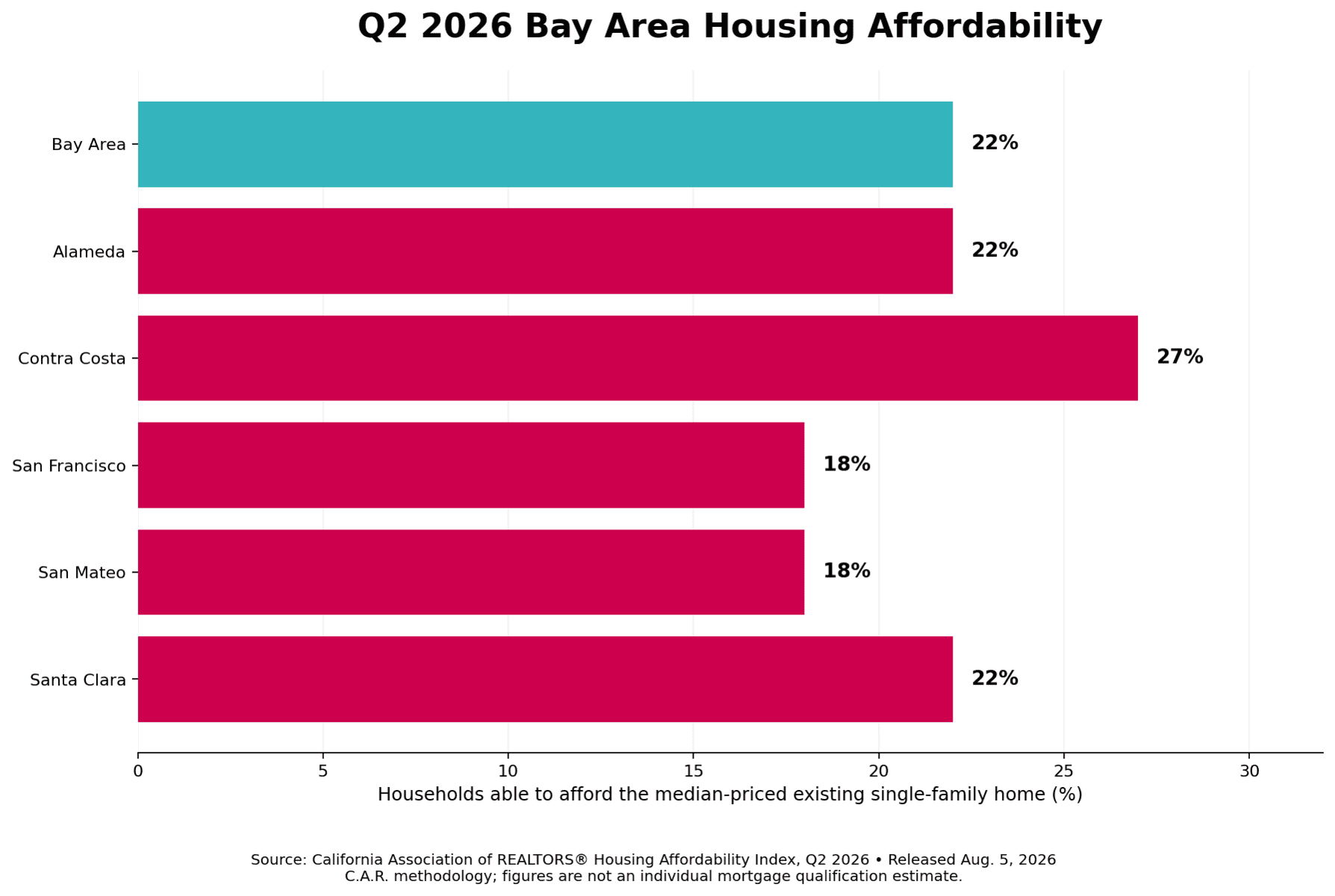
| Housing affordability | 22% | 20% in Q2 2025 | SF Bay Area | Median-priced SFH | Affordability remains a major constraint |
| 30-year fixed mortgage average | 6.69% | 6.66% previous week | U.S. | Conforming purchase applications meeting PMMS criteria | Financing remains a major monthly-payment variable |
C.A.R. market data covers June 2026; its affordability data covers Q2 2026. Freddie Mac’s rate is the national weekly average as of August 6, 2026, not a personalized mortgage quote.
The important lesson is that a regional median should never become your personal offer strategy. A condo in one city, an older detached home on the Peninsula and a remodeled house in Silicon Valley may each have completely different demand, condition and financing dynamics.
How Much Home Can You Comfortably Afford?
Start with the monthly cost you want to live with not the maximum purchase price a lender may approve.
Your ownership budget should consider:
- Principal and interest
- Property taxes
- Homeowners insurance
- Mortgage insurance, when applicable
- HOA dues, when applicable
- Maintenance and repairs
- Utilities
- Cash reserves after closing
- Future lifestyle and financial goals

C.A.R.’s Q2 2026 affordability methodology estimated that a household purchasing the Bay Area median-priced single-family home would need approximately $353,600 in qualifying annual income, based on its specified assumptions. That is a market-level affordability benchmark, not a statement about what an individual buyer can or should spend.
Do Not Forget Cash to Close
Your down payment is only one component.
The Consumer Financial Protection Bureau says closing costs commonly run approximately 2%–5% of the purchase price, excluding the down payment, although actual costs depend on the property, lender, loan and location.
Keep reserves instead of using every available dollar simply to reach the largest possible down payment.
Your first months as an owner may bring repairs, moving expenses, furnishings or costs you did not face while renting.
What Does the 2026 Market Mean for Buyers?
The current numbers do not say simply “buyer market” or “seller market.”
In June 2026, the Bay Area’s existing detached-home median was unchanged year over year, but sales increased. County results varied significantly. For example, Santa Clara County’s median was down year over year while San Mateo County’s was higher. C.A.R. also cautions through its methodology that median-price changes can reflect which homes sold, rather than an identical home’s change in value.
That is why your questions should become more specific:
- How many comparable homes are competing with this property?
- What recently sold nearby?
- How similar were those homes in lot, condition and floor plan?
- How long has this home been available?
- Has the seller changed the price?
- Does the property have issues that narrow its buyer pool?
- Are multiple buyers likely to compete at this price point?
A strong home in a highly sought-after micro-market can behave very differently from another property only a few miles away.
How Should You Prepare Your Financing?
Get financially ready before you become emotionally attached to a home.
Freddie Mac reported a national average 6.69% 30-year fixed mortgage rate on August 6, 2026. Your actual rate can differ based on credit profile, loan size, down payment, loan type, points and lender.
The CFPB recommends comparing at least three loan offers rather than assuming the first lender is automatically the best fit.
Compare more than interest rate:
- APR
- Points
- Lender fees
- Mortgage insurance
- Rate-lock terms
- Estimated monthly payment
- Estimated cash to close
- Loan flexibility
The CFPB’s standardized Loan Estimate is designed to make competing mortgage offers easier to compare.
Conforming vs. Jumbo Financing
For 2026, FHFA set the national one-unit baseline conforming loan limit at $832,750. In qualifying high-cost areas, the one-unit ceiling can reach $1,249,125. Verify the limit for the specific county and loan with your lender because applicable limits vary by geography.
That distinction matters in high-cost Bay Area purchases because loan structure can affect underwriting, reserves and financing strategy.
How Should You Choose a Bay Area Location and Property?
Start by separating needs from preferences.
Needs may include:
- Maximum comfortable payment
- Minimum bedrooms
- Home-office requirements
- Commute requirements
- Accessibility needs
- Property type
- Space for expected future needs
Preferences might include:
- Updated kitchen
- Particular architectural style
- Larger yard
- Additional garage space
- Cosmetic finishes
Then evaluate objective property and location characteristics independently:
- Commute time
- Traffic and noise
- Lot configuration
- HOA obligations
- Building age
- Maintenance requirements
- Natural-hazard considerations
- Insurance availability
- Nearby development
- Publicly available school information
- Permit history where relevant
A beautiful home that consistently conflicts with your everyday life can eventually feel like the wrong home.
Condo, Townhome or Single-Family Home?
Do not assume one property type is universally superior.
A condo may allow a buyer to enter a preferred location at a lower price than a detached home, but HOA dues, reserves, insurance and governing documents deserve careful review.
A townhome may offer additional living space with some shared-property considerations.
A detached single-family home may provide more autonomy and land, but often carries a larger purchase price and greater direct maintenance responsibility.

What Should You Know About Buyer Representation?
California’s buyer-representation rules changed substantially beginning in 2025.
California DRE explains that buyer-broker representation agreements are required under state law as soon as practicable and no later than execution of the buyer’s offer. Applicable trade-association practices may require an agreement before touring. The agreement addresses services, compensation and other representation terms. Compensation is negotiable, not a legally fixed or “standard” commission.
Before signing, understand:
- What services will be provided?
- How is compensation calculated?
- When could you be responsible for it?
- Can seller concessions cover some or all of it?
- How long does the agreement last?
- What are the termination provisions?
Never hesitate to ask for an explanation of a representation document before signing it.
What Due Diligence Should You Complete?
Do not let attractive staging replace investigation.
Depending on the property, appropriate due diligence can include reviewing:
- Seller disclosures
- Inspection reports
- Pest information
- Roof condition
- Foundation and drainage issues
- Electrical and plumbing systems
- Sewer information
- Permit history
- HOA documents and financials
- Natural-hazard disclosures
- Title information
- Insurance availability and cost
- Appraisal and financing conditions
Different properties justify different inspections. A qualified professional should evaluate matters outside your agent’s expertise.
Investigate Insurance Early
California’s Department of Insurance advises consumers to compare coverage, policy terms and exclusions carefully. Standard homeowners policies typically exclude certain perils such as earthquake and flood, and the available insurance solution can vary by property.
For that reason, do not leave insurability until the final hours before closing.
If a property presents unusual risk characteristics, obtain professional insurance guidance early enough for the answer to affect your decision.
How Should You Build an Offer?
Begin with value—not fear of losing.
A strategic offer considers:
- Comparable sales
- Current competition
- Property condition
- Seller priorities
- Financing strength
- Deposit structure
- Requested contingencies
- Closing timeline
- Your walk-away point
The highest price is not the only term in an offer. But neither should “strong terms” become shorthand for accepting risks you do not understand.
Decisions involving inspection, appraisal, financing or other protections should be made deliberately after understanding the consequences.
Before submitting an offer, ask yourself:
If this offer is accepted tonight, will I still feel comfortable with the price, property and risks tomorrow morning?
If the answer is no, the offer needs another review.
What This Means for Bay Area Home Buyers
| Stage | Buyer Priority |
| Before searching | Establish budget and financing |
| Selecting locations | Compare objective lifestyle and housing factors |
| Touring | Evaluate condition as well as appearance |
| Serious interest | Review disclosures and value |
| Before offering | Define price and risk limits |
| Negotiation | Balance competitiveness with protection |
| Under contract | Complete financing and due diligence promptly |
| Before closing | Verify loan, funds, insurance and final documents |
The objective is to move quickly when speed is useful, but never so quickly that you stop understanding the decision.
Local Bay Area Considerations
Silicon Valley and South Bay
Buyers may encounter everything from condominiums and newer townhomes to older ranch homes, remodeled properties and high-value detached homes. Compare lot utility, improvements, condition, permits, commute considerations and true comparable sales rather than assuming a city’s median determines an individual property’s value.
Peninsula
Higher-cost purchases can magnify the financial effect of financing, deferred maintenance and renovation decisions. Older housing stock in some locations also makes property-specific inspections and permit research especially important.
East Bay
The East Bay spans a large and diverse housing geography. Property type, commute pattern, terrain, insurance considerations and available housing stock may vary considerably from one city or submarket to another.
Across every area, evaluate the actual property and objective characteristics, rather than relying on stereotypes about neighborhoods or the people who live there.
Common Bay Area Home-Buying Mistakes
1. Shopping before establishing a comfortable budget
Preapproval is not the same thing as a personal spending target.
2. Focusing only on the listing price
The more useful question is what comparable homes indicate about value and what terms accompany that price.
3. Falling in love before reading disclosures
A property’s emotional appeal should never outrun your investigation.
4. Treating every Bay Area city as the same market
Competition may change by city, neighborhood, property type, condition and price range.
5. Ignoring insurance until late in escrow
Insurance availability and cost can materially affect affordability and financing.
6. Using every dollar for the down payment
Ownership becomes less peaceful when nothing remains for repairs, emergencies and ordinary life.
7. Trying to perfectly time rates and prices
You cannot control future mortgage rates or the next seller’s motivation. You can control preparation, budget, property selection and risk management.
[SHORT VIDEO PLACEMENT]
Step-by-Step Home-Buying Action Plan
- Define your ownership goals. Decide why you are buying and how long the home should serve you.
- Establish a comfortable monthly budget. Include taxes, insurance, HOA and maintenance.
- Preserve cash reserves. Do not treat every available dollar as down-payment money.
- Compare mortgage options. Request competing lender information and understand your financing.
- Define your search area and property types.
- Understand your buyer-representation agreement.
- Tour homes with a consistent evaluation framework.
- Review disclosures before making major risk decisions.
- Analyze comparable sales and property-specific value.
- Create a written offer strategy and walk-away point.
- Complete inspections, appraisal, insurance and lending tasks promptly once under contract.
- Review the Closing Disclosure carefully before closing.
For most covered mortgages, the CFPB states that the Closing Disclosure must be provided at least three business days before scheduled closing, giving buyers time to compare final terms with previous estimates.
Amar, REALTOR® Local Perspective
After years of watching Bay Area buyers become overwhelmed by listings, prices and competing opinions, one principle remains especially important:
Preparation should come before pressure.
I would separate every purchase into three decisions:
Is this the right HOME?
Does it genuinely fit your life and priorities?
Is this the right VALUE?
Do the property, condition and comparable sales support what you are prepared to pay?
Is this the right RISK?
Do you understand the disclosures, inspections, financing and contractual decisions you are making?

That approach is also consistent with recurring themes in Amar REALTOR®’s buyer-reference materials: a step-by-step process, detailed disclosure review, explaining property pros and cons and helping buyers understand a decision before moving forward.
Buying a home should feel exciting. But confidence comes from understanding why you are moving forward not simply from having an offer accepted.
Frequently Asked Questions
Is 2026 a good time to buy a home in the Bay Area?
It can be for a financially prepared buyer who finds the right property at an acceptable value. There is no single answer for the entire Bay Area. June 2026 regional sales increased year over year while the regional detached-home median was unchanged, illustrating why buyers should evaluate current micro-market conditions instead of trying to label the entire region.
How much income do I need to buy a home in the Bay Area?
There is no universal income requirement. C.A.R.’s Q2 2026 model estimated $353,600 of qualifying annual income for its median-priced Bay Area single-family home under its assumptions, but your actual purchasing power depends on price, down payment, debts, credit, rate, taxes, insurance and loan program.
Do I need 20% down?
Not necessarily. Available down-payment requirements depend on the mortgage program and borrower qualifications. A larger down payment can change the loan amount and possibly mortgage-insurance requirements, but buyers should consider cash reserves and total financial health rather than targeting 20% automatically.
What are typical buyer closing costs?
A useful early planning range is approximately 2%–5% of the purchase price, excluding the down payment, according to the CFPB. Actual Bay Area costs can differ materially by transaction, lender and property, so use your Loan Estimate for a transaction-specific number.
Should I waive contingencies to win a Bay Area home?
Not automatically. A contingency changes your contractual protection. Before modifying or removing one, understand the financial and legal consequences and evaluate the property’s disclosures, financing, appraisal and competition with appropriate professional guidance.
When should I obtain homeowners insurance?
Start investigating it as soon as a property becomes a serious candidate. California’s insurance market and property-specific risk characteristics can affect coverage and pricing, and standard homeowners policies also contain important exclusions.
Is a condo a better first home than a single-family house?
It depends on your budget and priorities. Condos can provide access to locations that might otherwise be unaffordable, while detached homes may provide different ownership and maintenance characteristics. For condos, examine HOA dues, financial health, reserves, insurance and governing documents—not just the purchase price.
Should I wait until mortgage rates fall?
Do not base your entire home-buying plan on an unverified prediction. Freddie Mac’s 30-year national average was 6.69% on August 6, 2026, but nobody can guarantee the direction or timing of future rates. Build your decision around a payment you can comfortably afford today and reassess financing opportunities when facts change.
How long does buying a Bay Area home take?
The timeline varies considerably. Financing preparation can be completed before searching, while the property-search period depends on your criteria and available inventory. Once under contract, the closing timeline depends on the agreement, financing, inspections, appraisal, title and other transaction requirements.
Conclusion
Buying a home in the Bay Area is a major financial decision but it is also the place where life happens.
The most successful mindset is neither fear nor urgency. It is clarity.
Know what you can comfortably afford. Understand your financing. Compare locations objectively. Study the property beyond its staging. Read the disclosures. Investigate insurance. Know the value. Understand your offer. And protect enough financial flexibility to enjoy the home after you receive the keys.
The right Bay Area buying decision is deeply personal, which is why regional statistics should begin your analysis—not finish it.
Create Your Personalized Bay Area Home-Buying Plan
Every buyer has a different budget, timeline, location preference and definition of the right home.
Let’s turn those priorities into a clear, property-focused buying strategy without pressure to purchase before you are ready.
Schedule My Home-Buying Consultation